

Somatic Practices at a Glance
Somatic Experiencing
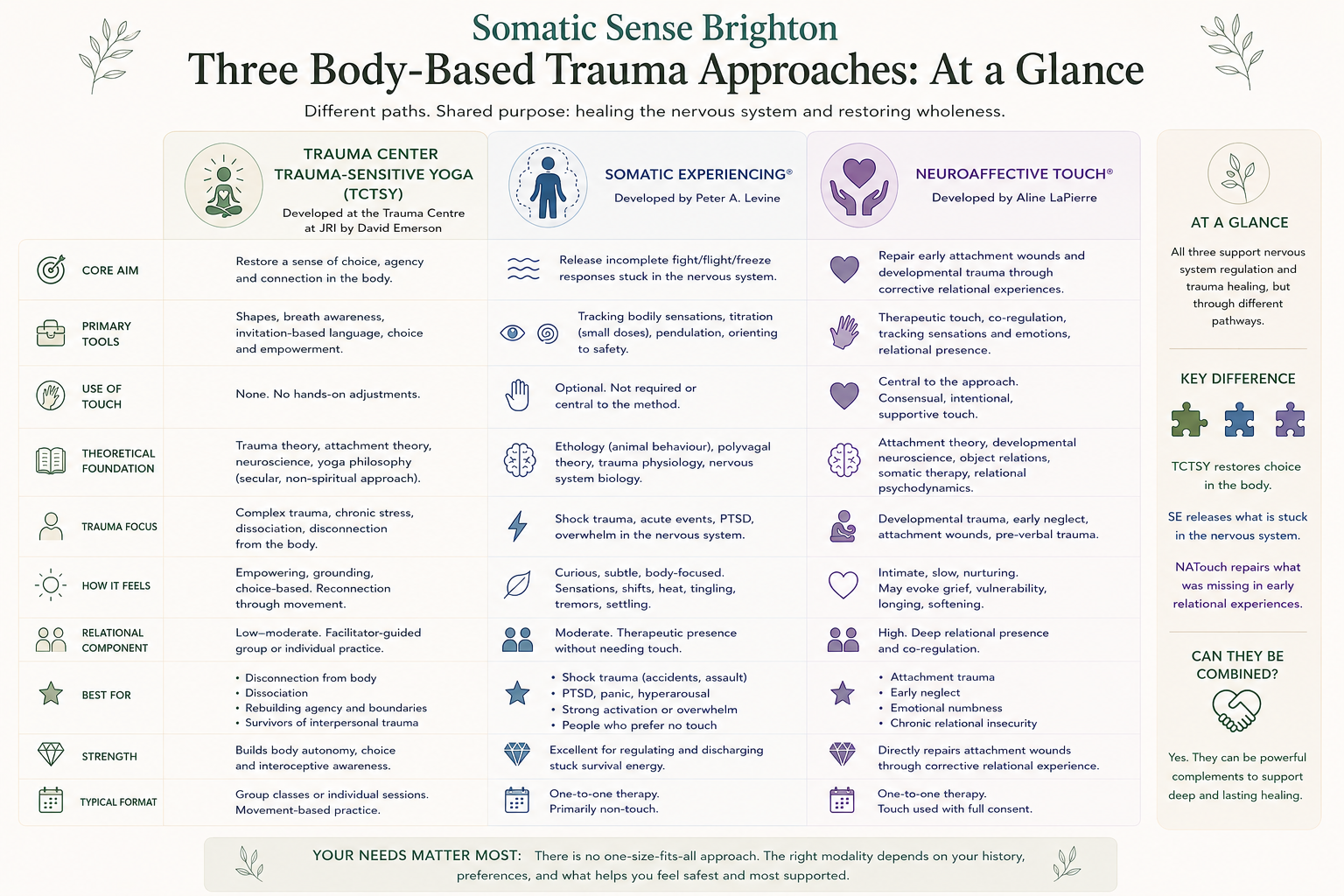
Somatic Experiencing® (SE™), developed by Dr. Peter Levine, is a body-oriented, trauma-informed therapeutic approach grounded in contemporary neuroscience and psychophysiology. In my practice, SE is used to address nervous system dysregulation related to trauma, chronic stress, and adverse life experiences.
SE is based on the understanding that trauma is not solely a cognitive or emotional issue, but a disruption of the autonomic nervous system (ANS)—the system responsible for survival, safety, and stress responses. Neuroscience research shows that traumatic experiences can overwhelm the nervous system, leaving it stuck in patterns of fight, flight, or freeze. Somatic Experiencing works directly with these physiological systems, rather than focusing only on thoughts, emotions, or narratives.
Rather than requiring prolonged exposure or detailed retelling of traumatic events—which may be contraindicated for individuals with limited affect tolerance or high dissociative vulnerability—SE emphasizes present-moment awareness of bodily sensations. Sessions gently guide attention toward sensations such as breathing, muscle tension, warmth, or subtle internal movement. By tracking these sensations at a slow and manageable pace, the nervous system can complete natural stress responses that were interrupted during overwhelming experiences.
Sessions are structured, collaborative, and carefully paced to support safety and stability while minimizing the risk of re-traumatization. The focus is on increasing the nervous system’s capacity for self-regulation, rather than analyzing or reliving past events. Over time, this process can help reduce symptoms such as anxiety, hypervigilance, emotional reactivity, shutdown, or disconnection from the body.
Somatic Experiencing is often helpful for individuals who feel stuck, overwhelmed, or disconnected, or who have not found sufficient relief through talk therapy alone. With consistent support, SE can foster greater regulation, resilience, and a growing sense of safety and ease in daily life.
Feel free to get in touch if you are curious about the approach.
Trauma Center Trauma Sensitive Yoga
“No intervention that takes power away from the survivor can possibly foster her recovery, no matter how much it appears to be in her own best interests.” - Judith Herman -
TCTSY is an evidence based yoga therapy to support survivors of complex/relational trauma. Originally developed by David Emerson and Jenn Turner at the Centre for Trauma and Embodiment at the Justice Resource Institute.
Research is increasingly showing the body as a critical way to help people in their recovery with trauma. During this practice you are invited to explore physical forms to practice noticing sensations (interoception or the ability to notice what is happening in your body) and make informed choices for you based on your somatic experiences within the context of a safe relational experience.
By focusing on the felt sense, TCTSY can support people to restore their connection of mind and body and nurture a sense of agency that is compromised as a result of trauma. TCTSY has shown promising benefits for many including survivors of domestic abuse, sexual assault, and childhood abuse, at risk-young people and war veterans. Please see Research & Resources for further information.
TCTSY is underpinned by attachment theory, neuroscience, and trauma theory and borrows from the Hatha yoga tradition. The TCTSY program qualified for inclusion in the National Registry of Evidence-based Programs and Practices (NREPP) database published by the Substance Abuse and Mental Health Services Administration (SAMHSA).
For more information and FAQ about TCTSY please click here, alternatively feel free to contact me by phone or email for an informal chat.
Rebecca currently offers TCTSY on a 1:1 basis. Feel free to reach out if you would like to explore further.
Yoga to Reconnect
“There is a voice that doesn’t use words. Listen” - Rumi
A therapeutic somatic based practice, where you will be invited to explore bodily sensations as you move through shapes. Focusing on reconnecting with or building on your felt sense, the practice supports being in the present moment and offers choice on how you take part. Increasing and decreasing intensity and sensation will be explored in the body. Guided by trauma informed research this practice creates a space to reconnect with your somatic self. Open to all. No previous yoga experience necessary, wheelchair accessible.
Sessions are limited to 8 spaces.
About your facilitator:
Rebecca is a certified trauma centre, trauma sensitive yoga facilitator (TCTSY-F). Please see the About Me page for details of training and background.
Details:
Thursday 6-7 p.m.
Patcham Memorial Hall
3 Old London Road, Brighton, BN1 8XR
Click here for information on how to get there.
Pre-booking required, get in touch to reserve a space.
Cost:
£12 per session after that or book 6 consecutive weeks for £65.
If finances are a concern please do get in touch to discuss your individual situation.
Neuroaffective Touch
NeuroAffective Touch® (NAT) is a therapeutic approach developed by Aline LaPierre, psychotherapist and founder of the NeuroAffective Touch Institute. It integrates touch, neuroscience, attachment theory and trauma therapy to support healing and integration.
Our earliest experiences of the world are shaped through our senses, with touch playing a particularly important role. A baby is held, soothed, rocked, nurtured and loved, and these experiences are felt primarily through touch. Our earliest experiences of safety, connection and belonging are non-verbal and are stored within the body and nervous system long before language develops.
These early experiences create a template for how we relate to ourselves, others and the world around us. Attuned, caring touch provides an essential foundation for healthy brain development and supports our emotional, relational and cognitive growth throughout life. When our early needs are not fully met, or when care is inconsistent or misattuned, we may develop patterns of disconnection that continue to affect our sense of self, relationships and wellbeing.
Drawing on principles from somatic psychotherapy, attachment theory and interpersonal neurobiology, NeuroAffective Touch can help increase self-awareness, support nervous system regulation and create opportunities to re-pattern long-standing ways of relating that may no longer serve us.
By working with both body and mind, NAT offers a bridge between physical and emotional experience. It can help access implicit, unconscious patterns and emotional responses that may not be fully available through talking therapies alone, while also offering more than bodywork by integrating relational and psychological processes.
Working with Rebecca
Rebecca is currently undertaking training in NeuroAffective Touch approaches. If you are interested in exploring this work, please get in touch to discuss your needs and to learn more about how NAT may fit within her current scope of practice and training.